
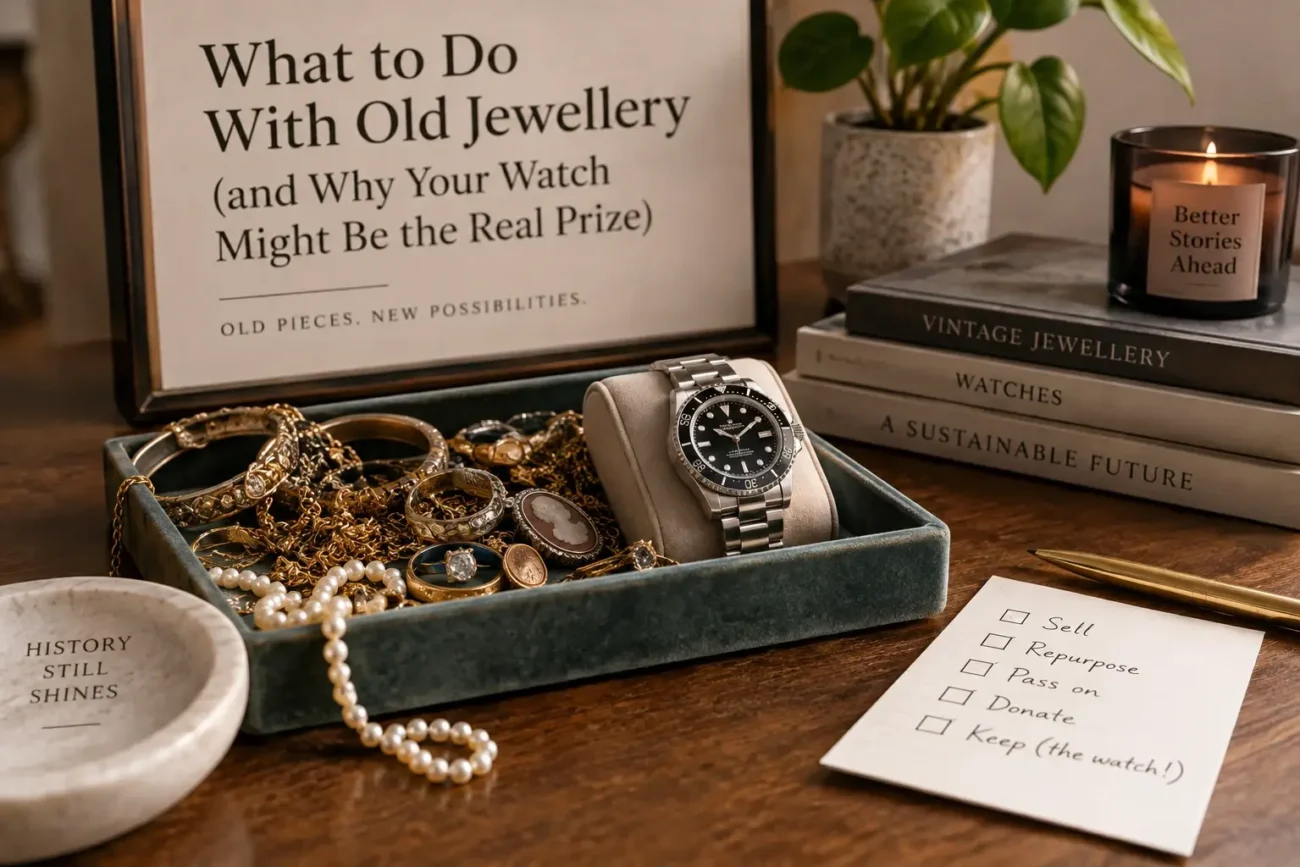
Picture two people in the same transaction, on opposite ends of it, neither one aware of the other. One is in their fifties or sixties, opening a drawer they haven’t looked in properly for years, finally deciding to sell a watch they stopped wearing. The other is in their twenties, scrolling a pre-owned listing on their phone, choosing that exact watch over a brand-new one on purpose.
Most articles about selling old jewellery only cover the first person. They talk you through why you might want to sell, then stop. Almost nobody asks who’s actually buying, and it turns out that’s the more interesting half of the story, because the buyer looks nothing like the wealthy fifty-something collector most people still picture when they think “watch buyer.”
The seller side of that opening image isn’t a guess, either. “Of the watches we bought in the last 12 months, around 80% have been from over 50s,” says Ben Steele of Watch Boutique. That’s a striking split once you put a number on it, and it’s exactly what makes the other half of the transaction worth asking about: if the sellers are overwhelmingly older, who’s actually on the other end buying what they let go?
Who’s actually doing the buying now
Deloitte’s Swiss Watch Industry Study puts a number on it: 40% of Gen Z and Millennial respondents say they’re likely to buy a pre-owned watch in the next year, a noticeably higher share than older age groups report. Boston Consulting Group found the same shift from a different direction, with 54% of Gen Z respondents saying their spending on luxury watches has gone up since 2021.
The UK figures put some real weight behind that. A 2024 Watchfinder and Opinium survey of 2,000 UK adults found that Gen Z, roughly 15% of the UK population and around 10 million people, already spends more on luxury watches than the market average across all ages. Over 10% of that group owns a timepiece worth between £1,000 and £7,500, against an 8% average for the population as a whole. Their combined spending power globally has been estimated above £350 billion, a figure that’s only going to climb as they earn more.
There are two reasons this keeps coming up in the research, and they’re tangled together more than most coverage admits. Younger buyers are frequently priced out of the traditional routes to building wealth their parents had, so a well-chosen watch increasingly gets treated as something closer to an asset than a splurge. At the same time, Vogue Business found 67% of watch buyers said a brand’s sustainability stance could influence a purchase, and a fifteen-year-old mechanical watch that’s still running fine simply doesn’t carry the stigma a fifteen-year-old phone would. You can’t easily separate “it’s a smart purchase” from “it fits how I want to shop” in this data, and honestly, most buyers probably can’t either.
What they’re choosing is different too
Rolex still leads by a wide margin. Roughly one in three luxury watches sold anywhere is still a Rolex, and that holds across every age group. But look just beneath that and the picture shifts. Cartier has become one of the standout brands specifically with younger buyers, pulled along by pieces like the Tank and the Santos, watches that read as design objects rather than a badge of status. Dealers describe the same thing from a slightly different angle: younger buyers reaching for dress watches and vintage or neo-vintage pieces they wear daily, often stacked with other jewellery instead of worn on their own as a statement piece.
A few things stand out when you look at how this generation buys, rather than just what it buys:
- They do the research themselves. Only 14% of Gen Z buyers say influencer content actually drives their purchase, and fewer still cite celebrities. Most of the legwork happens before they ever message a seller.
- They know the reference number before they see the watch. Recent sale prices, model history, common flaws — all checked in advance, not asked about on the day.
- They’re not buying to impress the same audience their parents were. A watch chosen to look considered, not expensive, is a genuinely different brief from a watch bought to be recognised.
If you’re the one selling, that third point matters more than it sounds like it should. A watch that would have struggled to find a buyer with an older, logo-focused audience can be exactly what a younger, taste-driven buyer is actively hunting for.
What this means if you’re sitting on one
None of this changes what your specific watch is worth on the day you sell it; a reference number is still a reference number. What it does change is the confidence you can have that selling is worthwhile at all. This isn’t a market being propped up by one good year for gold prices or a short-lived flipping craze. It’s being pulled along by a generation of buyers actively choosing secondhand over new, for reasons that go well beyond price.
Practically, that also means the two ends of this trade increasingly run through different specialists rather than one shop trying to handle both sides. In the UK, Watch Boutique works the selling side directly, valuing and paying private sellers for a watch without them needing to list it, photograph it or haggle over it themselves. Once a watch like that has been authenticated and serviced, it tends to re-enter the market through a retailer built for the buying side instead, someone stocking specific references for people who already know what they’re looking for rather than whatever’s newest in the window. Bramleys Luxury sits on that end of the trade, sourcing and reselling pre-owned watches and handbags to exactly that kind of considered buyer.
It’s a fairly tidy loop once it’s laid out: a watch someone stops wearing gets sold, gets checked over, and ends up on the wrist of someone who picked it deliberately. Neither person in that chain ever meets the other. But between them, they’re the reason this market keeps growing rather than shrinking.
The bottom line
A used watch used to be treated as a compromise, something you settled for if new was out of reach. That’s no longer really true, at least not for a meaningful and growing part of the market. A lot of buyers are choosing pre-owned on purpose now, for reasons that are as much about taste and values as they are about money. If there’s a watch sitting unworn in a drawer, that’s worth bearing in mind before deciding whether it’s worth selling, because the eventual buyer isn’t doing anyone a favour. They’re simply why this market exists.
This article was written with input from Watch Boutique, a UK-based specialist buyer of luxury watches including Rolex, Omega, Patek Philippe, Audemars Piguet, Breitling and TAG Heuer.
