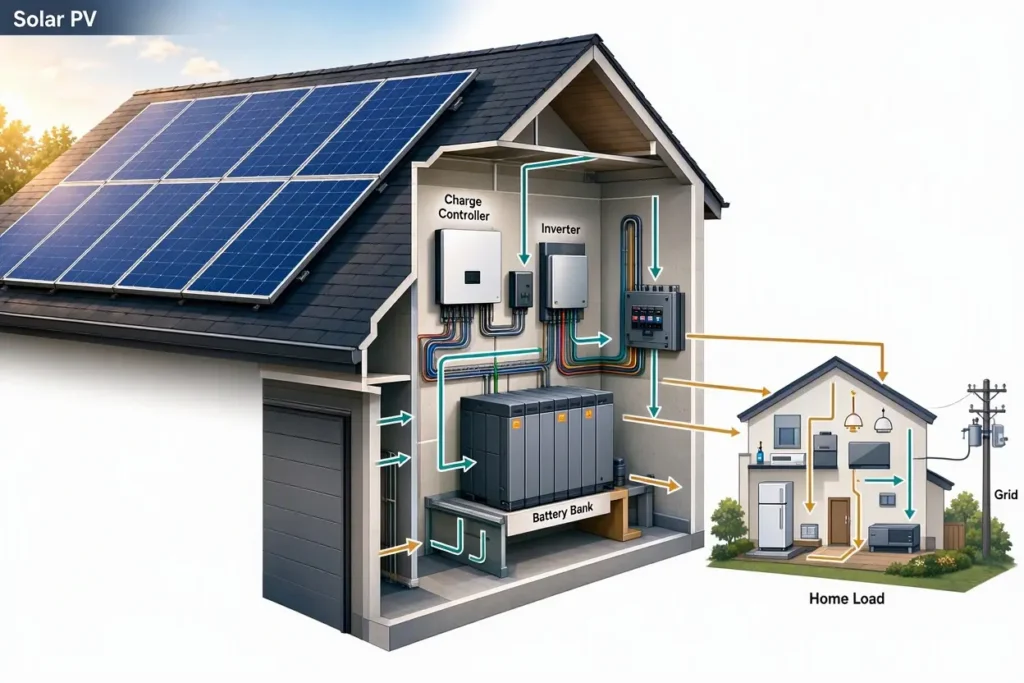
When rooftop PV produces more electricity than a home needs at a particular moment, storage can help shift some of that energy to a later period. A solar battery energy storage solution should be planned around the household load profile, battery-use expectations, and the existing electrical system. Project planning is easier when the main operating requirement is clear from the beginning. A sound project brief explains what must be measured, who will act on alarms, and how performance will be verified after installation. The central design task is to connect the selected equipment with a clear site requirement. Illustrative view of equipment used in 智能组串式构网型储能 projects.
Consider how storage will evolve
Electricity markets, grid codes, renewable capacity, and site loads can change over the life of a storage asset. A design review should consider whether the control platform, switchgear, protection, and physical layout can accommodate future operating modes. Flexibility is most useful when it is supported by a documented upgrade path rather than an undefined promise.
Make future expansion a practical scenario
Growth assumptions should be translated into specific triggers, such as additional racks, more PV capacity, new vehicle chargers, or a changed household load. The team can then identify which cables, switchgear, floor space, communications, and controls need to be reserved. This is more useful than simply labeling a design as future-ready. For a closer look at the solution scope, review solar battery energy storage solution and consider how its documented functions fit the site layout, electrical interfaces, and operating plan.
Commission with realistic operating scenarios
Acceptance testing should cover the intended charging and discharging modes, communications, protective trips, control handoffs, and recovery procedures. If grid-forming operation is part of the design, the relevant tests need to be coordinated with the network operator and other plant systems. A successful factory test does not replace verification of the installed site.
Grid-forming capability changes the system role
Some storage projects are designed not only to follow an existing grid reference but also to contribute to voltage and frequency stability. Grid-forming functions can be relevant in systems with high renewable penetration, weak-grid conditions, or microgrid operation. The actual capability depends on the full plant design, control settings, protection coordination, and requirements of the network operator. Performance should always be assessed against the actual installation conditions and the complete system boundary.
Safety needs several coordinated layers
Battery safety is addressed through cell selection, pack and rack design, thermal management, electrical protection, detection, isolation, and operating procedures. A layered approach helps prevent a local abnormal condition from becoming a wider system event. Safety planning should cover manufacturing, transport, installation, commissioning, operation, maintenance, and end-of-life handling. A project specification for solar battery energy storage solution should identify the applicable configuration, installation limits, commissioning checks, and service responsibilities.
Evaluate lifetime value across the project
A storage investment should be assessed over its expected operating life rather than only by initial installed cost. Degradation, auxiliary consumption, availability, maintenance, replacement strategy, warranty conditions, and revenue assumptions all affect the economics. Sensitivity analysis helps show how the business case changes when electricity prices, cycle frequency, or dispatch rules differ from forecasts.