
I Tested 100+ Productivity Tools for 5 Years. Only 7 Survived. Here is the autopsy of what failed, and the deep dive into the seven that became non-negotiable.
We live in an era of “productivity porn.” Every week, a new Notion-killer launches on Product Hunt, promising that its revolutionary bi-directional linking or AI-integrated task management will finally be the thing that fixes your chaotic life.
Five years ago, I fell for all of it. As an investigative journalist covering the tech sector, I turned my own workflow into a laboratory. I didn’t just “try” apps; I migrated my entire life into them. From the minimalist cult of Roam Research to the maximalist behemoths like Monday.com, I spent half a decade chasing the ultimate friction-free system.
The result? I spent more time “tooling” than actually working. I was a professional architect of systems that produced nothing but more systems.
In early 2024, I hit a breaking point. I realized that the best productivity stack isn’t the one with the most features; it’s the one that disappears. Today, in 2026, the dust has settled. Out of the 100+ platforms, plugins, and “second brains” I experimented with, my workflow has been stripped down to the essentials.
The Great Bloat: Why Most Tools Fail the Longevity Test
Before we get to the survivors, we have to talk about why the other 93+ tools ended up in the digital graveyard.
Most productivity software suffers from feature creep. A tool starts as a great way to take notes, then adds a calendar, then a task manager, then an AI chat, then a whiteboarding tool. By trying to be everything to everyone, they become a “jack of all trades, master of none.”
I found that the tools I abandoned generally fell into three categories:
- High-Maintenance Systems: Tools that required 30 minutes of “daily maintenance” just to keep the dashboard accurate.
- The “All-in-One” Trap: Apps that did everything mediocrely, forcing me to compromise on the quality of my writing or project tracking.
- The Proprietary Prisons: Apps that made it nearly impossible to export my data, holding my intellectual property hostage.
The seven survivors aren’t necessarily the “flashiest” tools. In fact, some of them are quite boring. But they all share a common trait: Atomic Utility. They do one thing better than anyone else, and they play well with others.
1. The Anchor: Notion (The Only “All-in-One” That Actually Scaled)
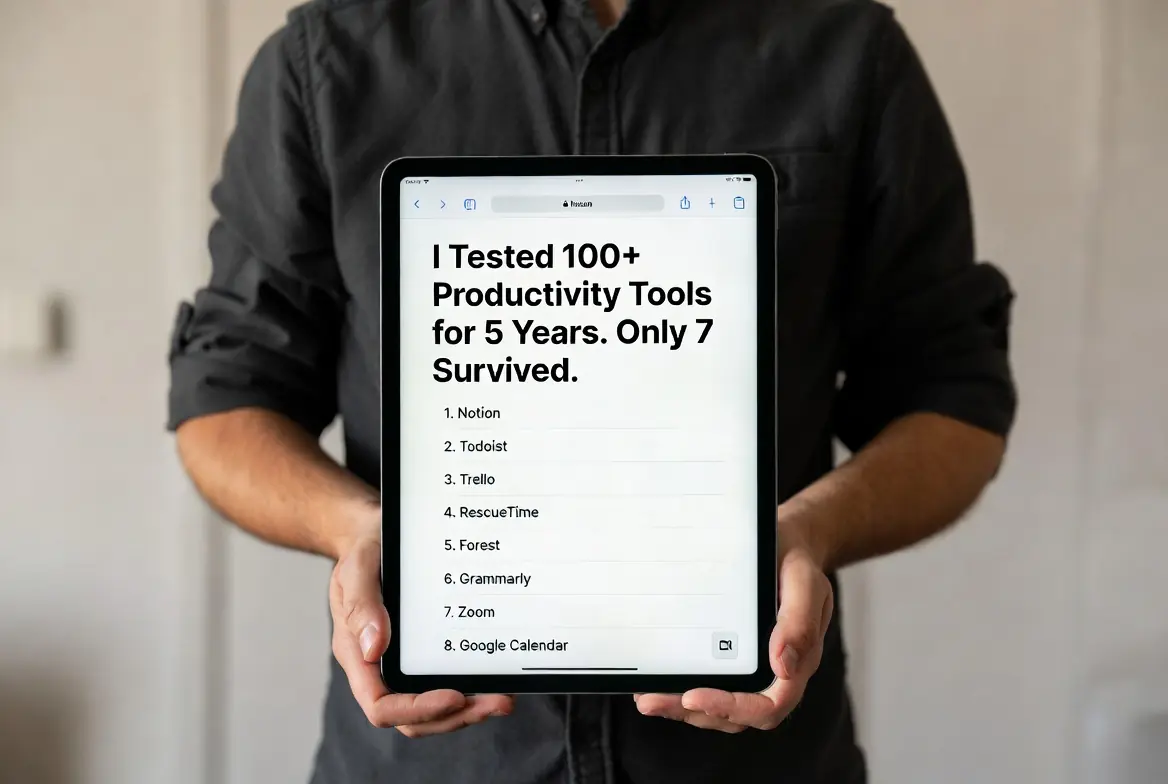
It might seem hypocritical to praise Notion after bashing “all-in-one” tools, but Notion is the exception because it is a meta-tool. It’s not an app; it’s a construction kit.
Over five years, Notion transitioned from being my “everything” to being my Single Source of Truth (SSOT). I don’t use it for quick tasks or rapid-fire notes anymore—it’s too slow for that. I use it as a structured wiki for my life and business.
Why it survived:
In 2026, Notion’s database functionality remains unmatched. The ability to create a “Master Content Calendar” where a single entry can be viewed as a gallery for brainstorming, a table for SEO metadata, and a timeline for production is indispensable.
The 2026 Use Case:
I use Notion for Systems, not Actions. * Standard Operating Procedures (SOPs): How I research a story.
- Knowledge Bases: Every book I’ve read in the last five years is summarized here.
- CRM: Tracking long-term relationships with editors and sources.
The Insight: Use Notion as your library, not your notepad. When you treat it as a static archive of your systems, the “clutter” disappears.
2. The Engine: Obsidian (The Second Brain for Deep Thinkers)
If Notion is my library, Obsidian is my workshop. During my five-year experiment, I spent two years in Roam Research, but I eventually migrated everything to Obsidian.
Obsidians survival comes down to one word: Ownership. ### The Local-First Revolution: Obsidian works on top of local Markdown files. If the company goes bankrupt tomorrow, my notes remain on my hard drive, readable by any text editor. In an age where SaaS companies disappear overnight, this is the ultimate hedge against “digital link rot.”
Why it’s better than the rest:
The “Graph View” isn’t just a gimmick. For an investigative journalist, seeing the connections between disparate pieces of evidence is how breakthroughs happen. Obsidian’s plugin ecosystem (specifically Dataview and Templater) allows me to automate the organization of my thoughts without the manual overhead of Notion.
Pro Tip: Don’t over-organize your folders. Use “links” (the [[Bracket]] method) to let your ideas find each other naturally. Structure should emerge, not be imposed.
3. The Gatekeeper: Akiflow (The Final Boss of Task Management)
I tried Todoist. I tried Things 3. I even tried a paper Bullet Journal for six months. None of them survived. Why? Because a task list without a calendar is just a wish list.
Akiflow survived because it solves the “fragmentation” problem. As a professional, my tasks don’t just come from my head. They come from Slack, Gmail, Trello, and Zoom.
The Power of Time Blocking:
Akiflow pulls every “inbox” into one view and allows you to drag those tasks directly onto your Google Calendar. This forces a reality check: Do I actually have the 4 hours required for this deep dive, or am I lying to myself?
The 2026 Edge:
The “Command Bar” is the fastest in the industry. I can hit a shortcut, type “Call Editor Friday at 2pm,” and it’s scheduled, categorized, and synced across all devices in three seconds.
4. The Invisible Assistant: Readwise (The Knowledge Loop)
We consume a staggering amount of information—articles, Kindle books, Twitter threads, PDFs. Most of it is forgotten within 48 hours.
Readwise is the only tool that has consistently increased my “Return on Investment” for reading. It acts as the bridge between consumption and creation.
How it works in my stack:
- Capture: I highlight anything interesting on my Kindle or via the Reader app.
- Sync: Readwise automatically exports those highlights into my Obsidian “Second Brain.”
- Review: Every morning, Readwise sends me a “Daily Review” of 5 random highlights from my past.
Why it survived:
It solves the “out of sight, out of mind” problem. I’ve written entire investigative pieces based on a random highlight from a book I read four years ago that popped up in my morning review. It turns passive reading into active utility.
5. The Communication Surgeon: Loom (Killing the “Meeting That Could Have Been an Email”)
In the last five years, “Zoom fatigue” became a clinical reality. My productivity plummeted when my day was sliced into 30-minute meetings.
Loom survived because it reclaimed my time. Instead of a “quick sync,” I send a 2-minute video.
The Editorial Value:
As an editor, I use Loom to record my screen while I’m moving through a writer’s draft. I can explain why a paragraph isn’t working with nuance and tone that text simply can’t convey. It’s faster for me to record, and faster for them to watch at 1.5x speed.
The 2026 Standard: If you can’t explain it in a 3-minute Loom, you probably aren’t ready for a 30-minute meeting anyway.
6. The Clean Slate: Raycast (The macOS Command Center)
For Mac users, Raycast is the successor to Alfred and the replacement for Spotlight. It is the “glue” that holds my seven survivors together.
Why it’s essential:
Instead of clicking through my dock or searching for browser tabs, I use Raycast for everything:
- Window Management: Snapping windows to half-screen.
- Clipboard History: Accessing something I copied three hours ago.
- Snippet Expansion: Typing
;sigto instantly paste my professional signature. - Quick Search: Searching my Notion docs or Obsidian notes directly from the search bar.
It eliminates the “micro-frictions” of navigating an OS. Over a year, saving 5 seconds on a search 50 times a day adds up to hours of reclaimed “flow state” time.
7. The Deep Work Sanctum: Freedom.to
The greatest threat to productivity in 2026 isn’t a lack of tools; it’s the abundance of distractions. No matter how good your “system” is, if you spend three hours on algorithmic feeds, you’ve lost.
Freedom is a “nuclear option” for focus. It blocks websites and apps across all my devices (Phone, iPad, Mac) simultaneously.
The Survival Factor:
Most “blockers” are easy to bypass. Freedom is notoriously difficult to quit once a session has started. During my “Deep Work” block from 8:00 AM to 11:00 AM, my internet is strictly limited to the tools I need.
The Insight: Productivity is more about what you don’t do than what you do. Freedom protects the space where the real work happens.
The Ghost of Tools Past: What Didn’t Make the Cut?
To understand the value of the 7 survivors, we have to look at the “almost” winners.
The Trello/Asana Fatigue
I spent years in Kanban boards. While they are great for teams, I found that for individual “deep workers,” they become a source of anxiety. Seeing a column of 50 “To Do” cards is a recipe for paralysis. I shifted to Time Blocking in Akiflow, which focuses on when I will do the work, not just what the work is.
The AI-Native Notes (The 2025 Hype)
Last year, there was a surge of apps that “write for you.” I tested them extensively. While AI is a great sounding board, the tools that tried to automate the thinking process actually made my writing worse. Productivity is about sharpening your mind, not replacing it.
How to Build Your Own “Survivor” Stack
If you are feeling overwhelmed by the sheer volume of choices, don’t try to implement all seven of these at once. Instead, follow the Audit, Strip, and Build method.
Step 1: The Tool Audit
List every app you use for work. Ask yourself: “If this app disappeared tomorrow, would I be relieved or devastated?” If the answer is “relieved” (because you’d no longer have to update it), delete it immediately.
Step 2: Identify Your Friction Points
Where does your day fall apart?
- If you lose notes -> Get Obsidian.
- If you forget tasks -> Get Akiflow.
- If you can’t focus -> Get Freedom.
Step 3: The 30-Day Rule
Never add a new tool to your workflow during a busy period. Wait for a “low” week, implement one tool, and use it for 30 days before adding another.
The Philosophy of “Subtraction Productivity”
The most significant lesson I learned after testing 100+ productivity tools for 5 years is that complexity is a mask for procrastination. We spend hours customizing our Notion dashboards because it feels like work, but it doesn’t require the vulnerability of actually putting words on a page or making a difficult sales call.
The seven tools that survived my experiment are successful because they are transparent. I don’t “play” with them. They are the infrastructure that allows me to do the one thing that actually matters: Create.
The Hierarchy of Digital Needs:
- Storage (Notion): Where the stuff lives.
- Thinking (Obsidian): Where the ideas grow.
- Scheduling (Akiflow): Where the time is guarded.
- Learning (Readwise): Where the input is filtered.
- Efficiency (Raycast/Loom): Where the friction is removed.
- Protection (Freedom): Where the focus is saved.
The Bottom Line
Your productivity is not defined by the apps on your phone; it’s defined by the output of your brain. The “perfect” system is the one that you actually use when you’re tired, stressed, and behind on a deadline.
After 5 years and 100+ tools, I’ve realized that the goal isn’t to be a “power user.” The goal is to be a person who gets things done and then closes their laptop to go live their life. You can read more interesting news and blogs on daily basis only on writeforusfashion.
Frequently Asked Questions
1. Isn’t Notion too slow for quick tasks?
Yes. That is a major reason why I stopped using it for “To-Do” lists. Notion is a great “refrigerator” (storage) but a terrible “stovetop” (action). Use something like Akiflow or even a simple Apple Note for things you need to jot down in 2 seconds.
2. Is Obsidian difficult to learn for non-tech people?
It has a learning curve, but you can ignore 90% of the features. If you just open it and start writing, it’s as simple as Notepad. You only need to learn the “fancy” stuff (like Dataview) if you have a specific problem that needs solving.
3. Why not just use Google Calendar for everything?
Google Calendar is great for recording appointments, but it’s bad at managing “tasks that don’t have a fixed time.” Akiflow sits on top of Google Calendar to bridge that gap, allowing you to see your “Fixed” time and “Fluid” time in one place.
4. Do I really need to pay for productivity tools?
Most of the tools I mentioned have excellent free tiers. However, I view my productivity stack as my “office rent.” If paying $10/month for a tool like Readwise saves me two hours of research time, it has paid for itself a hundred times over.
5. Can I use these tools on Windows/Android?
Most of them, yes. Raycast is Mac-only (Windows users should look at PowerToys), and Things 3 (which I didn’t include) is Apple-only. Obsidian, Notion, Readwise, and Akiflow are all cross-platform.
6. What about AI? Should I use an AI-first tool like Reclaim or Motion?
I tested Motion for a year. While the AI auto-scheduling is impressive, I found it often made “stressful” choices, cramming my day too tight. I prefer the manual control of Akiflow. AI should be an assistant, not the pilot.
7. How long does it take to set up this “survivor” stack?
Don’t rush it. It took me five years to find this balance. Start with one—perhaps Obsidian for your notes—and let it settle for a month. Productivity is a marathon, not a sprint.
Leave a Reply