
Scotland’s largest city, Glasgow, is bathed in the architectural splendor of days gone by. With its roots stretching back to prehistoric times, the city boasts a rich and varied architectural heritage that reflects its journey through the centuries.
The cityscape is a palimpsest of styles, from the medieval Glasgow Cathedral which stands as a testament to Gothic grandeur, to the Victorian tenements carved with ornate stonework that speak of another era’s craftsmen. The period from 1860 to 1910, known as Glasgow’s ‘golden age’ saw an upsurge in industrialization and population growth which subsequently led to massive urban expansion.
The prolific sandstone buildings and iconic red and blonde stone buildings sprouted during this epoch still add a distinctive character to the city’s skylines. Their timeless aesthetic appeal mingled with myriad historical tales they hold within their walls invokes a unique charm only older structures can impart.
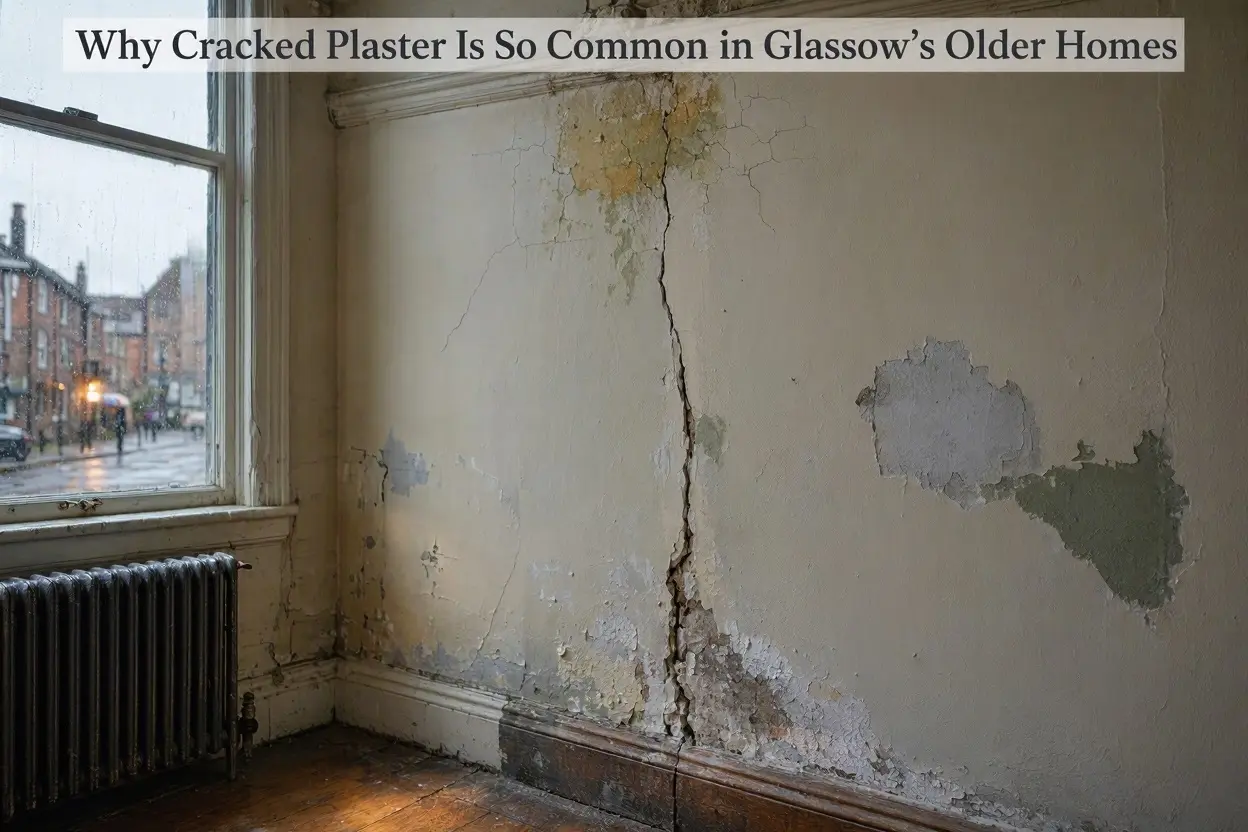
However, as captivating as they are on first glance these venerable edifices are not without their own set of problems. One seemingly minor yet persistently aggravating issue frequently found amongst these older homes are walls lined with cracked plaster – an affliction many Glaswegians have come face-to-face with over time. JD Decor can provide you with advice about professional inspection and repair of your cracked plaster.
The Cracks Beneath The Surface: A Silent Dilemma
Cracked plaster may seem like just another symptom of ageing infrastructure at first glance but delving deeper it becomes evident that it is indeed much more than meets the eye. Hidden beneath this worn veneer lies stories not only of elapsed time but also of changing environmental conditions, construction methods employed decades ago and most importantly the undeniable fact that even greatest creations call for attention at times. Deteriorating plasterwork in older homes is far from being an isolated issue.
In fact, it is rather common and considered a serious problem plaguing homeowners in Glasgow. These ‘cosmetic’ flaws often lead to more significant problems if not addressed in due course, including compromised structural integrity and potential health issues due to mold growth.
Understanding why cracked plaster is such a prevalent issue in Glasgow’s older homes requires a journey through history, an exploration of architectural traditions, and inquiry into the science of building materials. Only then does it become clear that what seems merely like lines drawn on walls are indeed patterns chronicling tales of a city’s past, while also posing challenges for the future.
The Silent Specter: Cracked Plaster in Glasgow’s Older Homes
Amidst the architectural tableau of Glasgow – a city renowned for its rich historical tapestry – lurks a silent specter: cracked plaster. This ubiquitous blight, often deceptively hidden beneath layers of paint or tastefully arranged wall art, is not merely an aesthetic inconvenience but a haunting manifestation of the passage of time. It seems that the city’s architectural splendor is, in part, paid for by these hidden cracks beneath the surface.
Cracked plaster is more than just another bullet point on the long list of homeownership headaches; it’s an issue that pervades many older Glaswegian homes. The character-filled cobbles and blue-blooded tenements may scream charm and antiquity, but their very age makes them particularly susceptible to this uninvited guest.
Cracked plaster is a quiet invader, slowly spreading its spidery tentacles across walls and ceilings until one day it becomes impossible to ignore. It pervades living rooms and bedrooms alike with its insidious presence, proving that time does indeed leave its imprints everywhere.
A Statistical Marvel: The Frequency of Cracked Plaster in Glasgow
The prevalence of cracked plaster in Glasgow’s older homes can be demonstrated through intriguing statistics. A survey conducted by Glasgow Building Preservation Trust revealed that around 65% of residential buildings dating back to the Victorian era report issues related to cracked plaster. This alarming figure indicates that cracking isn’t an isolated issue affecting only a handful of unlucky homeowners; rather it points to a systemic problem deeply rooted within Glasgow’s aging residential architecture.
These numbers underscore how this phenomenon has become all too common within these otherwise picturesque abodes. The statistics don’t simply reveal prevalence; they also offer insight into societal habits.
The same study found that a startling 70% of homeowners prefer to cover the damage, hiding the cracks beneath wallpaper or fresh coats of paint, rather than addressing the root cause. This finding highlights a predilection for temporary fixes over comprehensive solutions — a Band-Aid approach that only serves to prolong and potentially exacerbate the issue.
Cracked Stories: Case Studies and Examples
Case studies provide tangible examples of cracked plaster’s far-reaching impact. One such instance is the Barrowland Ballroom, a popular Glasgow concert venue housed in an early 20th-century building.
Despite extensive renovations in recent years, issues with cracking plaster persist, often leading to closures and costly repairs. Another poignant example is The Pearce Institute in Govan.
A stunning example of Scottish Baronial architecture dating back to 1906, it has struggled with cracking plaster over recent years. Despite persistent repair efforts, these manifestations of time refuse to disappear completely.
The prevalence goes beyond just public buildings; countless Glaswegian homeowners tell tales of their battles with cracked plaster. Living in historical homes brings its charm and character but also this silent specter which seems hell-bent on etching itself into every corner possible.
The Unseen Impact: Consequences for Homeowners and Residents
Cracked plaster might seem like merely an aesthetic concern on surface level — an unsightly blemish marring otherwise pristine walls or ceilings — but its impact runs deeper than mere appearance alone can reflect. The emotional toll on residents can be significant; living amidst constant decay can engender feelings of helplessness and frustration as one battles against time’s relentless onslaught.
There are also additional pressures when homeowners must balance historic preservation with modern living standards. Beyond emotional impact, there are financial implications too; routine repair work places significant strain on homeowners’ wallets, as they attempt to mitigate the damage caused by cracked plaster.
Then there are health hazards – from potential exposure to old paint or materials beneath the plaster and the possible development of mold due to moisture seepage. The silent specter of cracked plaster, it appears, has louder reverberations than first meets the eye.
The Architecture of Glasgow’s Older Homes
Unveiling the Architectural Tapestry of Glasgow’s Historical Homes
Glasgow, a city encapsulating centuries of history, boasts an impressive architectural patrimony that is as diverse as it is enigmatic. From Victorian townhouses to Georgian terraces and Art Nouveau masterpieces, the cityscape is an amalgamation of styles that provides a tangible chronicle of its past.
The older homes specifically hold a distinct charm, their walls bearing silent testimony to the passage of time. The most prevalent architectural style in these vintage domiciles can be traced back to the Victorian era, characterized by intricate detailing and robust design structures.
Red sandstone facades are a common sight, with ornate cornice work and mouldings adding an element of grandeur. Georgian buildings, on the other hand, exude simplicity and symmetry with their austere facades often concealing opulently decorated interiors.
Art Nouveau or ‘Glasgow Style’, championed by architect Charles Rennie Mackintosh in the early 20th century added another layer to Glasgow’s architectural tapestry. These abodes are embellished with organic motifs and asymmetrical designs making them unique additions to Glasgow’s older homes landscape.
Plaster: A Testament to Historical Craftsmanship
Foremost among the materials used in these homes is plaster – a material intrinsically linked with architectural embellishment throughout history. Traditionally composed from lime, sand and water mixtures, plaster was primarily used due both its functional benefits – providing smooth interior surfaces for decoration – as well as its aesthetic appeal when molded into ornamental features such as cornices or ceiling roses. Indisputably one of its most lauded characteristics is plaster’s versatility; it can be smoothed onto walls or ceilings into flat finishes but also intricately moulded into decorative features.
The latter is particularly evident in the grand townhouses of Glasgow, where plasterwork adorns the ceilings and cornices with an almost sculptural quality, showcasing the skilled craftsmanship of yesteryears. Plaster also provides sound and heat insulation – a vital feature in the often inclement Scottish weather.
Its porous nature allows it to ‘breathe’, providing a natural regulation of humidity within homes. Moreover, when maintained well, plaster proves to be exceptionally durable – its longevity evidenced by its presence in historical buildings still standing centuries on.
The Dualism of Plaster: Benefits Versus Drawbacks
Despite its versatility, durability and aesthetic appeal, plaster is not without its flaws. An integral aspect of dealing with heritage architecture involves understanding that time eventually bares these imperfections – often manifesting in hairline fractures or larger cracks on wall or ceiling surfaces.
One core drawback lies within plaster’s very composition; as a rigid material, it lacks flexibility. Thus, it tends to crack under pressure – whether from natural settlement over time or due to more abrupt structural shifts.
This can result in unsightly blemishes marring otherwise flawless interiors. Furthermore, while the porosity allows for moisture regulation thereby preventing dampness buildup; if water ingress occurs from leaks either internal or external sources–the normally beneficial porosity becomes a liability.
Absorbed water can lead to mold growth behind the plaster surface which apart from being visually unappealing also has significant health implications. Ultimately though, despite these drawbacks – the allure of original plasterwork remains undeniable; holding an irreplaceable place within Glasgow’s architectural legacy where it serves as a vivid chronicle of design trends across various historical periods.
Unveiling the Causes for Cracked Plaster in Older Homes
The Impact of Ageing Infrastructure and Wear and Tear Over Time
The longevity of any architectural marvel is inherently tied to the progression of time, its repeated brushing ultimately manifesting as wear and tear. This unequivocally holds true for Glasgow’s older homes. The ageing infrastructure, tottering on the precipice of decay, bears the brunt of years passing by.
Walls that once stood strong now gracefully bow to their inevitable fate, their plaster facade sporting an intricate network of cracks. This deterioration often stems from a lack of regular maintenance over vast periods.
Older homes in Glasgow with plaster walls reflect a bygone era where quick fixes were not always readily available or prioritised. Consequently, minor structural imbalances or damages left unattended have escalated into major issues over time.
Furthermore, even well-maintained older homes are not impervious to this trend. With age comes brittleness; plaster that has been stalwartly clinging onto laths for more than a century eventually succumbs to gravitational pull, leading to hairline fractures which expand into noticeable cracks over time.
The Role of Scotland’s Unique Climate Conditions
Scotland’s climate presents an amalgamation of unpredictably variant weather conditions – from bone-chilling wintry winds to soaking summer downpours. These atmospheric extremities exert an unsparing toll on Glasgow’s older homes’ building materials, particularly plaster. Inconsistent temperature fluctuations cause repeated expansion and contraction cycles in the plaster material which leads it prone to cracking over time.
The cold Scottish winters make the plaster contract while summers cause it to expand; this constant push-pull effect weakens its structural integrity and contributes significantly towards cracking. Beyond temperature variances, Scotland’s often moisture-laden air poses another challenge.
This high humidity level can lead to moisture absorption in plaster, causing it to swell and subsequently crack when it dries. The plaster’s porous nature makes it particularly susceptible to this issue, hindering its longevity in the face of Scotland’s unique climate conditions.
Historical Construction Methods: A Contributing Factor?
Glasgow’s older homes stand as a testament to its rich architectural history. However, the historical construction methods employed during their creation might inadvertently contribute towards the problem of cracked plaster. Traditional plastering involved applying several coats of lime-based plaster onto wooden laths.
Although this technique has proved durable and allowed for artistic flexibility, its inherent flaws become apparent over a significant span of time. The key lies in understanding that while lath and plaster walls provided breathability, they lacked modern day concepts of thermal efficiency and damp proofing.
Dampness is a nemesis for lime-based plasters. When traditional materials like these are exposed to contemporary living conditions involving regular heating or introduction of modern insulation materials, they can retain more moisture than they were designed to handle leading to cracks over time.
Unravelling the Science Behind Cracked Plaster
The phenomenon of cracked plaster in older homes can be attributed to several scientific factors, each contributing to the degradation of this once prevalent building material. First and foremost among these is the impact of temperature fluctuations on plaster.
As with many materials, plaster expands when heated and contracts when cooled. This cyclical process over time can lead to the formation of cracks as the material is repeatedly stretched and shrunk.
Scotland’s climate is known for its sudden changes and temperature fluctuations, a factor that exacerbates this problem. During Glasgow’s colder months, the contraction that occurs as temperatures plummet can result in significant stress on the plaster, increasing its propensity for cracking.
Conversely, during warmer periods, expansion may cause previously small cracks to enlarge further. Beyond temperature fluctuations, another key scientific factor behind cracked plaster is moisture absorption.
Plaster is a porous material that absorbs moisture from its surroundings – an attribute that intensifies under Glasgow’s often damp climate conditions. This absorbed moisture not only causes the plaster to expand but also weakens its overall structure over time, making it more susceptible to cracking.
Economic Factors: The Costly Reality of Maintaining Aged Edifices
Understanding why cracked plaster is so common in Glasgow’s older homes wouldn’t be complete without discussing economic factors at play. Maintenance costs associated with aging infrastructure are a central concern here. Upkeep of older buildings often comes with hefty expenses due to their unique architectural elements and materials used – including plaster walls which require specific expertise for appropriate restoration or repair.
In addition to maintenance costs per se, urban development policies can indirectly contribute to this issue too. Limited incentives or support for maintaining older homes may push homeowners towards more affordable yet short-term solutions – masking rather than addressing underlying issues like cracked plaster.
A Hidden Danger: Health Risks Lurking Beneath Cracked Plaster
Cracked plaster in older homes is more than an aesthetic or structural issue; it carries potential health implications as well. One such danger is the growth of mold due to moisture seepage through the cracks. Residents may unknowingly breathe in these spores, which can lead to respiratory problems over time.
Beyond mold risks, exposure to old paint or materials underneath deteriorating plaster can also pose hazards. Older buildings often used lead-based paints or asbestos, substances now known for their serious health risks when disturbed or exposed.
Seeking Solutions: Mending and Preventing Cracked Plaster
The issues presented may seem daunting, but there are solutions available for cracked plaster in older homes. One approach is engaging professional services that specialize in repairing damaged plaster. These experts have the skills and knowledge to restore the material’s integrity without compromising its original character – a crucial aspect for heritage buildings.
For minor cracks, DIY solutions could suffice too using specific filler products followed by careful sanding and repainting once dried. Additionally, preventative measures like controlling indoor humidity levels and regular inspections can help mitigate the issues caused by both temperature fluctuations and moisture absorption.
The Silver Lining of Aging Infrastructure
While Glasgow’s older homes face challenges like cracked plaster due to a variety of scientific, economic, and health factors – they are far from defeat. With a combination of professional expertise for major repairs, do-it-yourself methods for minor ones, preventive maintenance measures, we can ensure that these architectural treasures continue standing tall amidst modern structures while providing safe abodes for their residents. In this dance between past and present lies an opportunity – not just to preserve historical character but also learn from it as we shape our future built environment.
