
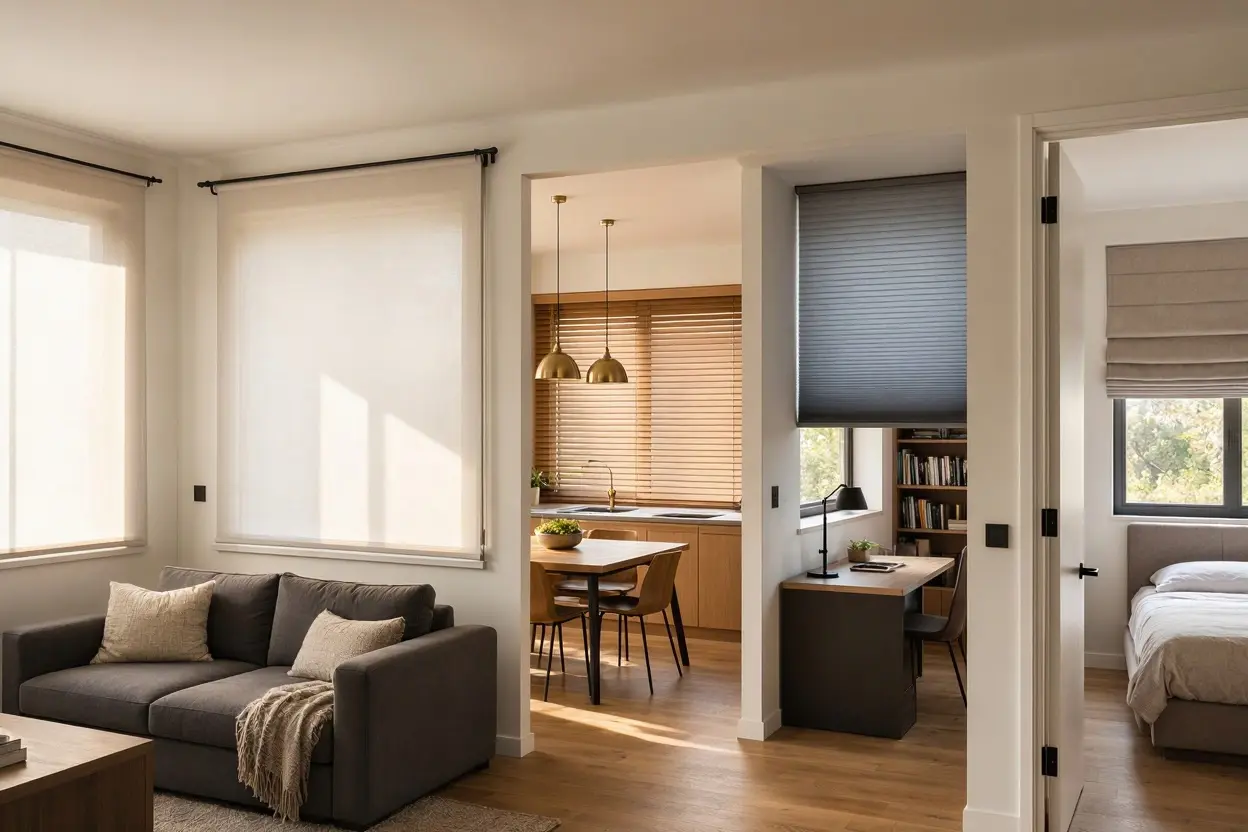
Using the same blind in every room can make a house feel coordinated, but it can also ignore the fact that different rooms do very different jobs.
A kitchen may need something practical and easy to live with. A bedroom may benefit from softer light control. A bathroom has different privacy and moisture considerations, while a living room may be driven more by colour, texture and how the window sits within the furniture scheme.
Consistency does not have to come from repetition.
A home can use several blind styles successfully if there is a clear visual thread running through them. Colour, material, proportion and overall character can do far more to unify a scheme than insisting that every window looks identical.
Start with a whole-home palette
The simplest way to mix blind styles is to give them a shared colour language.
That does not mean every blind needs to be the same shade.
Instead, choose a small family of tones that already appears throughout the home. This might include:
- warm white;
- stone;
- taupe;
- muted green;
- soft grey;
- natural timber;
- or deeper accents such as charcoal or navy.
Different rooms can then use different treatments while still feeling related.
A warm neutral blind in the living room, a slightly deeper version in the bedroom and a cleaner pale tone in the kitchen can all belong to the same scheme even if the mechanisms differ completely.
Match character before matching product type
Two blinds can look coordinated without being the same style if they share the same overall character.
For example, a relaxed woven blind in a living room may sit comfortably with a simple roller blind in a kitchen if both use soft natural colours and understated materials.
Likewise, a more tailored blind in a dining room may work beside a plainer bedroom treatment if both have crisp lines and a restrained palette.
Think about words that describe the home as a whole.
Is it:
- calm;
- contemporary;
- traditional;
- relaxed;
- colourful;
- minimal;
- or layered?
The blind in each room should contribute to that character, even if its construction changes.
Let the room decide the mechanism
Blind styles should respond to how a room is actually used.
A treatment that suits a quiet bedroom may be unnecessary in a busy kitchen. A large glazed door may need a different solution from a small bathroom window.
This is where consistency through identical products can become restrictive.
Rather than forcing the same blind everywhere, ask what each room needs from its windows.
Consider:
- privacy;
- daylight;
- glare;
- window movement;
- access;
- cleaning;
- moisture;
- furniture position;
- and how often the blind will be adjusted.
For households looking at openshaw blinds across several rooms, it can be more useful to establish a shared palette first and then let each opening use the treatment that best suits its function.
The visual connection can remain strong even when the blind type changes.
Repeat colours where architecture repeats
When similar windows appear close together, consistency becomes more important.
Two adjacent windows in the same room will usually look better when their treatments feel clearly related. The same applies to a row of windows visible from one hallway or an open-plan space where several openings are seen at once.
This does not always require identical blinds.
A shared colour may be enough.
If one window needs a more practical treatment and another requires a softer one, keeping the tone similar can make the difference in mechanism feel intentional rather than random.
Repeat where the architecture repeats; vary where the function changes.
Use one dominant neutral to connect the house
A useful approach is to choose one neutral that appears in several rooms.
This could be warm white, stone, mushroom, pale grey or another restrained shade.
That colour can then act as the visual anchor.
It might appear as:
- the main blind colour in the living room;
- a lighter variation in the kitchen;
- the background colour of a patterned bedroom blind;
- or a related tone in curtains elsewhere.
The exact shade can shift slightly according to the room.
What matters is that the eye recognises a consistent family.
Allow bedrooms to feel softer
Bedrooms often benefit from a gentler treatment than kitchens, hallways or home offices.
That difference should not be seen as inconsistency.
A fabric with more texture, a deeper colour or a softer visual finish can make sense where the room is intended to feel calmer and more private.
The connection to the rest of the house can come through colour rather than mechanism.
If the main home uses warm neutrals, the bedroom might move into warmer taupes or muted earthy tones while keeping the same underlying palette.
This gives the room its own atmosphere without disconnecting it from the wider scheme.
Keep kitchens visually cleaner
Kitchens often contain more hard surfaces, cabinetry and fittings than other rooms.
The blind can therefore benefit from being visually simple.
A clean treatment in a colour that relates to nearby walls or cabinetry may work better than a highly decorative style.
That does not make it less connected to a softer living-room blind.
If both share similar undertones or visual restraint, the transition between the rooms can still feel natural.
This is particularly useful in open-plan kitchen-living spaces, where several blind types may be visible at the same time.
Use bathrooms as a functional variation
Bathrooms often have specific privacy and moisture considerations, so the treatment may need to differ from the rest of the home.
That practical change does not need to disrupt the design scheme.
Keep the colour connected to nearby rooms.
A soft grey used elsewhere might reappear in a more suitable bathroom material. A warm white could continue through the home while the blind construction changes according to the environment.
Consistency should never require using an inappropriate material simply because it matches another room.
Let living rooms carry more personality
The living room is often the place where the window treatment can contribute more strongly to the overall design.
Texture, richer colour or subtle pattern may make sense here because the room usually contains more furniture, artwork and decorative layers.
If the rest of the house is restrained, this can become the room where the palette feels most expressive.
The trick is to stay within the same design language.
A muted green blind in the living room can still relate to stone-coloured blinds elsewhere if both sit comfortably within the same natural palette.
One room can have more personality without making the rest feel disconnected.
Avoid assigning a completely different colour story to every room
Changing blind style is usually easier to manage than changing both style and colour repeatedly.
If every room has a different product, different colour family, different pattern and different hardware, the home can begin to feel fragmented.
Some variation is useful, but there should be a limit.
A practical rule is to vary one or two elements at a time.
For example:
- different mechanism, similar colour;
- different colour, similar texture;
- different texture, similar hardware;
- or stronger pattern, familiar background tone.
This creates variation within a recognisable framework.
Coordinate rooms that are visible together
Sightlines matter more than whether rooms technically have separate doors.
Stand in the hallway, on the landing or at the junction between open-plan spaces and look through the house.
Which blinds are visible at the same time?
Those treatments need the strongest relationship.
A bedroom upstairs can be more independent if it is rarely seen alongside the living room. A kitchen and dining area that sit within the same view need greater coordination.
Plan around visual relationships rather than room names.
This often creates a more natural whole-home scheme.
Use hardware as a quiet linking detail
Hardware can help several blind styles feel more connected.
That might include:
- similar headrail colours;
- related control finishes;
- consistent metal tones;
- or a shared level of visual simplicity.
These details do not need to match exactly in every room.
What matters is avoiding obvious clashes.
If the home uses warm brass and timber elsewhere, highly visible cool chrome components may feel disconnected. If black frames and fittings repeat throughout the property, darker hardware may create a stronger relationship.
Small details can carry consistency surprisingly well.
Keep pattern concentrated rather than scattered
Pattern is easier to mix when it appears selectively.
A patterned blind in every room can quickly create visual competition, especially if the designs are unrelated.
Choose where pattern genuinely contributes.
A bedroom, dining room or sitting room might support it well, while kitchens, bathrooms and circulation spaces remain quieter.
Where pattern is used, repeat one of its colours elsewhere in the house.
This creates continuity without duplicating the design.
The eye notices shared colour more naturally than repeated motifs.
Use texture as the bridge between different treatments
Texture can connect blinds that are otherwise quite different.
A lightly woven living-room fabric, a simpler bedroom material and a more practical treatment elsewhere can still sit together if they share a similar visual softness.
This is particularly effective in homes where natural materials such as timber, wool, linen and stone already repeat.
The blinds become another layer within that material story.
Texture often provides a more subtle form of consistency than exact colour matching.
Let window size influence the treatment
Whole-home consistency should not ignore scale.
A blind that looks balanced on a small bedroom window may feel visually weak on a wide living-room opening.
Likewise, a treatment designed for large glazing may feel bulky on a narrow window.
Different proportions may therefore justify different styles.
The key is to preserve the wider palette and character while adapting to the opening.
A successful whole-home scheme does not make every window behave identically. It makes each one feel like a considered variation.
Think about the view when blinds are open
Consistency is not only about the closed position.
Many blinds spend much of the day open.
Look at how the treatments sit when retracted.
Do some leave large amounts of material visible while others nearly disappear? Are headrails very prominent in one room but minimal elsewhere?
These differences may be perfectly acceptable, but they should suit the architecture.
A more decorative living-room treatment can tolerate greater visual presence. A modern kitchen may benefit from a cleaner open position.
What matters is that each choice feels deliberate.
Use curtains selectively rather than everywhere
Some rooms may benefit from curtains as well as blinds, particularly bedrooms and living rooms.
Other spaces may not need them.
That difference does not undermine consistency.
Curtains can actually help establish hierarchy between rooms.
A living room with layered curtains and blinds may feel softer and more formal, while the kitchen uses a simpler blind in the same colour family.
The shared palette keeps the spaces connected while the extra layer responds to how each room is used.
Keep transitions between floors in mind
Upstairs and downstairs can have slightly different moods without feeling like separate houses.
Ground-floor rooms may lean more towards practical, sociable and visually connected treatments. Bedrooms upstairs can become softer, deeper or more private.
A shared neutral or recurring accent colour can link them.
This gives the house progression.
Consistency should not mean that walking upstairs reveals exactly the same design repeated again.
Variation can make the home feel more considered when the underlying relationships remain clear.
Do not let one difficult window dictate the entire house
Some homes contain one unusual opening: a bay, roof window, French door or large glazed section.
That specialist opening may need a completely different blind style.
There is no reason to make every other window copy it.
Instead, connect it through colour, texture or visual weight.
This allows the unusual window to receive the treatment it genuinely needs without distorting the design decisions elsewhere.
Function should lead first; consistency can be added afterwards.
Review the house from room to room
Before finalising a whole-home scheme, walk through the property in sequence.
Move from entrance to living room, kitchen, stairs, landing and bedrooms.
Notice how the window treatments appear as you move.
Ask:
- Does any room feel unexpectedly disconnected?
- Does one colour appear nowhere else?
- Is one treatment much heavier than the surrounding scheme?
- Are adjacent rooms competing?
- Does the variation feel purposeful?
This is a more useful test than looking at every room separately.
A home is experienced as a sequence, not a collection of isolated photographs.
A whole-home consistency checklist
Before choosing different blind styles across the property, consider:
- What is the main colour family?
- Which neutral can repeat throughout the house?
- Which rooms genuinely need different mechanisms?
- Which windows are visible together?
- Where should pattern appear?
- Can texture provide a shared visual thread?
- Are hardware finishes reasonably consistent?
- Do bedrooms need a softer character than practical spaces?
- Are nearby windows coordinated where architecture repeats?
- Does each blind suit the scale of its opening?
- Are specialist windows being treated according to function rather than forced into the scheme?
- Do open positions look appropriate for each room?
- Does the house feel connected when walking from one space to another?
The goal is not sameness. It is recognition.
Consistency comes from relationships, not repetition
A well-designed home does not need one blind style repeated in every room.
Different spaces deserve treatments that respond to their own privacy, light, practical and decorative needs.
What makes the scheme coherent is the relationship between those choices: recurring colours, compatible textures, similar levels of visual restraint and a clear sense of the home’s overall character.
When those elements are established first, changing the blind style from room to room feels intentional rather than inconsistent.
Frequently Asked QuestionsDo all blinds in a house need to be the same colour?
No. Related tones often create a more interesting result than exact repetition. A small whole-home palette can allow each room to use a slightly different shade while still feeling connected.
Can I use different types of blinds in adjoining rooms?
Yes. Different rooms may have different practical requirements. If the blinds are visible together, connecting them through colour, texture or hardware can help the transition feel deliberate.
Should bedrooms match downstairs window treatments?
Not exactly. Bedrooms can usually feel softer or more private while still using colours and materials related to the rest of the home.
How many blind colours should I use throughout a house?
There is no fixed number, but a restrained palette is easier to coordinate. One recurring neutral plus a few related supporting shades often creates enough variety without making the house feel fragmented.
What is the easiest way to make several blind styles look consistent?
Start with colour and overall character. If the different treatments share compatible tones, textures and visual weight, they can feel coordinated even when their mechanisms are completely different.
